What can you do with a leaky germanium transistor?
Leaky germaniums are all too common and if you select the good devices from a bag of transistors, you will have a pile of rejects that are not suitable for fuzz or booster circuits. What can you do with them?
You can use them as diodes. The base-emitter junction will have a forward voltage drop of about 0.25v and can be used as a clipper in a fuzz circuit.
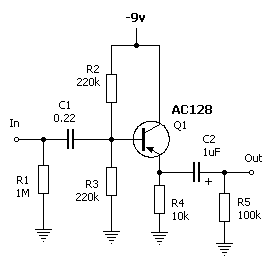
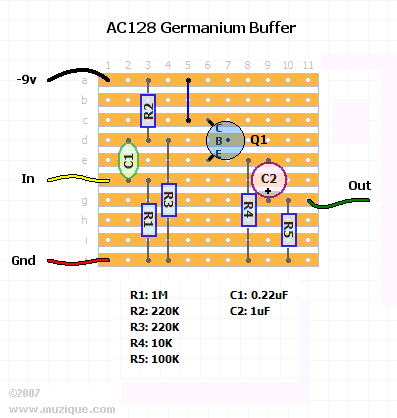
Also, even though the transistor may have too much b-e current leakage for use in many circuits, it can still probably be used as a buffer. The basic circuit is shown at the start of this article and it can be built on stripboard using the same layout as for the jfet buffer that I published previously. The transistor pin configuration is different for the germaniums so you will have to match the leads to the proper pads.
Also, an AC128 or similar transistor will require a positive ground, so the battery power connections will have to be reversed. The black battery lead will go to the top row of connections on the stripboard and the red battery lead goes to the Gnd pad.
If you want to increase the input impedance of the Ge buffer, change the values of R2 and R3 to 470k.
I breadboarded this circuit last night using an AC128 with 700uA of leakage current and got good performance. A 2.5v pk-pk triangle wave was passed by the buffer with no visible distortion on the oscilloscope display.
You could even parallel Ge buffers as I did with the jfets, and make a germanium buffer/splitter!
Here is a sample stripboard layout for the buffer:
This circuit can also be built on the AMZ Multi-Purpose PCB.





Good information and glad to read about the testing you have done.
Cheers,
RP
Be sure to look at the negative ground version of this buffer:
http://www.muzique.com/news/index.php/?p=45
-Jack
I did some tests with several leaky germaniums in this buffer and got response over 100k Hz!
Read more:
http://www.muzique.com/news/index.php/?p=46
-Jack
Nice work Jack! Saving the world by keeping components out of the ground! In some way this should be submitted to Nuts and Volts or some other publication as a Green Buffer, or the start of Green Circuits! Keep the lead out! Great idea, best of luck.
Robert
You should try some Ge transistors in the buffer positions of your compressor… it will add some nice ‘flava’
For those who don’t know, Robert makes some great custom guitar fx pedals. Check them out at:
Keeley Electronics
regards, Jack
Thanks!,
Hi – I like this very much although I haven’t tried it yet, but I was wondering if it would be possible to add a collector resistor equal to R4 to give a balanced output to XLR, or to give the choice of in or out of phase signal ?
Thanks so much, Rob
Great circuit agree with the “green” comments above. Does anybody have a good gain control and tuner/mute mod to add to this circuit? If not, I’ll see what I can come up with.
I used a russian ge with a forward bias of 80 and little to no leakage, but, I have issues. The wah will work before the amplifier but sounds very low in volume and it sounds scratchy when the wah is rocked back and forth. The wah is fine without the buffer. In front of a fuzz face, with the fuzz face on, no sound passes? Bizarre indeed. I’m going to go back to it and if I wired something wrong. Does the leakage and bias matter with the device?
Okay, I found part of the problem. I soldered in the transistor the wrong way, so, I removed it and put in a AC128. Unfortunately, I’m still having problems. There is an increase in volume but still no sound with the fuzz engaged, and it is still scratchy. I’m stumped.
Ugh! Do I feel like an idiot. I realized that this is positive ground and won’t work properly in a negative ground circuit. I took it apart and rebuilt it using the proper schematic (negative ground) posted here at the beginning of this post. And, it works perfectly.
Great! I’m glad you got it working!
regards, Jack
Can i ask how to make a simple boaster